|
Monday, Dec. 01, 2008
|
 |
 |
|
 |
Cigar FAQ (Frequently Asked Questions)
|
| Cigar
Basics |
|
|
|
| Cigar Smoking and Etiquette |
Back to Top
|
|
|
| Technical Aspects |
Back to Top
|
|
|
| Storage Methods |
Back to Top
|
|
|
| Cigar Accessories
|
Back to Top
|
|
|
|
|
Back to Top
|
|
It always helps to know which end is which and what
everything is called. The majority of cigars come with one open end (the foot)
which is the end that you will light. The other end (the head) is the end
that you must cut, and through which you will draw air and delicious smoke. To
make life easier, the band is most often placed near the head.
Cigar Parts
A cigar is composed of three types of tobacco; the
Filler (the guts), the Binder (which holds the filler together) and the Wrapper
(which holds everything together).
The Filler
The filler can be from any part of the tobacco
plant. The top of the plant usually produces the strongest flavor, while the
bottom produces the tobacco with the best burning properties. Most cigars have
blended fillers (fillers from varying parts of the plant and varying sources) to
achieve the correct taste and burning qualities.
|
| What
is a "premium" cigar? |
Back to Top
|
| The term
"premium", when applied to cigars, indicates that it is not a
machine made, mass market style of cigar. In order to be classified as
such, it will have the following characteristics: Premium cigars are
constructed from three parts; The filler, the binder, and the wrapper. The
filler is the interior of the cigar. When a cigar is examined from the
open end, the filler can be seen as the leaves that are twisted in spirals
within the center of the cigar. When the term "long filler" is
used, it means that the filler was constructed from full leaves. These
leaves are picked, stored, and aged intact, and are obviously handled with
great care. Rolling long filler cigars takes great skill to insure that it
burns evenly and smoothly. The second type of filler is short filler.
Short filler consists of loose clippings of leaves that are leftover from
the long filler production, or leaves that broke anywhere along the
cultivation process. Premium short filler cigars are made from 100%
tobacco leaves, but just not the same leaf from end to end. Short filler
cigars are still technically considered to be "premium", so long
as the cigar is still completely hand made, and is constructed only from
pure, untreated or unhomogenized tobacco. The next part of the cigar
consists of several layers of leaves that encircle the spirals of filler.
These layers are termed "binder". As the name implies, it forms
the filler into a circular shape, so that the next, and final component,
the wrapper, can be applied.
|
| What
is a "Puro"? |
Back to Top
|
| A puro is a cigar
that was made entirely from the tobaccos of one county. An example of the
most well known Puros are Cuban cigars. In Cuba, the filler, binder, and
wrapper is all grown in Cuba. Cigar manufacturers who make Puros consider
it a great honor to be able to achieve a such a level of sufficiency, as
it gives them more control over the consistency and quality of the
finished product. The difficulty in acquiring the necessary native
ingredients in producing a puro make them very rare indeed. Other than
Cuban cigars, which are unavailable in the American market, there are only
a handful of Puros out there. The Breton Corojo Vintage, Corojo2000, and
the Opus X are all excellent quality Dominican Puros.
|
| What
are the basic shapes of premium cigars? |
Back to Top
|
| There are two shapes of cigars, Parejos and Figurados. A Parejos is a straight sided cigar. A Figurado is an exotic, irregular shape.
|
| What
do the two numbers mean when applied to cigar sizes? |
Back to Top
|
| They are the length
and ring gauge (diameter). The length is measured in inches. The ring
gauge is measured in units of 1/64th's of an inch. For example, a cigar
that is called "8 x 48" is 8 inches long and 48/64ths of an inch
in diameter.
|
| Do
the opposite ends of the cigar have different names? |
Back to Top
|
| Yes. The end you cut
and smoke though is the "cap". The end you light is called a
"tuck" or "foot".
|
| Does
the cigar's name indicate its dimension? |
Back to Top
|
Quite often they do.
There are some basic shapes that fall within certain size parameters.
These shapes are given names, so that there is some degree of universality
in the industry. These descriptive dimensions are approximate, but here
are some guidelines: Short is less than 5.5 inches. Long is greater than
6.5 inches. Thin is less than 42 ring size. Thick is greater than 47 ring.
The group below are the most common shapes.
- Robusto:
Short and thick
- Lonsdale:
Thin and long
- Corona:
Medium length and medium gauge
- Churchill: Long and thick
- Cigarillo: Short
and thin
Please note that these are only generic shape names. For example, a
Robusto from one brand may have slightly different dimensions than a
Robusto from another brand.
There are other shapes that fall between and around these basics:
- Toro:
Somewhere between Robusto and Churchill.
- Panatela:
A skinny Lonsdale.
- Rothchild:
Somewhere between a Robusto and a Corona.
- Presidente: Either a little larger or smaller than a Churchill
Manufacturers can also add one of these common adjectives to the name.
They can help you to envision the size. Gorda, Grande, Gran, Larga, Extra,
Doble, or Double always mean they are adding on to the size. Petite, Slim,
Finos, or Demi indicate some sort of reduction to the size. For example a
"Corona Grande" is a long Corona, and would be close to a Lonsdale.
On top of all this we will now add the Figurados. Here are the basic
definitions. Note, you will find more disparity here among brands than you
can imagine. When you are dealing with Parejos, you can be positive that
Robustos from different brands will always resemble each other to some
degree. However, with Figurados, almost anything goes. One company's
Torpedo will be another's Pyramid or Perfecto. These are the most common
descriptions for the shape names on today's market. Remember, all
dimensions described are approximations.
- Torpedo:
The cap is a sharp point, the foot is open. The
shape does not begin to taper until the last 2 inches near the cap.
The foot will measure between 46 to 54 in ring size. The length can
range from 5 to 7 inches.
- Piramide:
The cap is round, the foot is open. The cigar will
immediately taper from the foot right down to the cap. For this
reason, many Piramides will be described with two ring sizes. For
example, 7 x 36-50. This means that it is a seven inch cigar, and the
tuck is 50 ring, and it drops down to 36 by the time it reaches the
cap.
- Triangulo:
Similar to a Piramide, but the cap is pointed.
- Belicoso:
Similar to a torpedo, but usually a little shorter.
Also, the taper will occur even more quickly than the torpedo,
typically occurring within the last 3/4" near the cap.
- Perfecto:
The perfecto will have both ends closed. The cap
can be round or pointed. The tuck is typically tapered to the width of
a cigarette. On some brands, you light the foot as is, and with
others, if it is more than 3/8", you clip off a bit to expose the
filler. The sides can be straight, or there can be a bulge in the
first half of the cigar near the foot. The length of a perfecto can
vary from 4-8"
- Diadema:
Traditionally, this is a giant perfecto, measuring
at least 8" long. However, it is can be used to name any huge
scale version of the Figurados described above.
- Culebra: Three panetelas twisted around each other and held
together with either ribbon or a large cigar band. The segments of a
traditional Culebra will be composed of all ligero filler, not mild
seco and volado fillers of a regular Panetela. You must separate them
before smoking. Do not attempt to straighten out the wavy shape. Smoke
them in the curved way that they have been cured.
|
| How
do I know what size is right for me? |
Back to Top
|
| You should pick a
cigar for the amount of time you have available to smoke. If you are at a
sporting event or on a golf course, choose a large cigar that will last
for a long time. If you are in a cigar friendly restaurant and you want to
have a nice after dinner smoke, (but don't want to stay there all night)
choose one that will last about 30-40 minutes. These are just some
examples. As you experiment with different sizes you will find one that
you are most comfortable with.
|
| What do the
cigar ratings mean? |
Back to Top
|
| We use the ratings
from one of the most trusted sources, Cigar Aficionado.
Cigar Aficionado's ratings are scored on the
100-point scale:
95-100 - classic
90- 94 - outstanding
80-89 - very good to excellent
70-79 - average to good commercial quality
Below 70 - don't waste your money
To check out cigar ratings for yourself on their website,
Click
Here
|
| How do I open the end cap? |
Back to Top
|
| The most common way is with a cigar cutter. This means you will clip the rounded end cap off. Other methods are discussed
in detail here.
|
| Is there a correct way to light a cigar? |
Back to Top
|
| Absolutely. Your goal is light
the end as evenly as possible. When lighting the cigar, it is best when
you apply as little of the flame to the end of the cigar as possible. This
will prevent the tobacco from getting charred, or carbonized, and
imparting an unpleasant taste unto it. To do this, hold the flame about 2
inches away from the cigar, and slowly draw long puffs of air through the
cigar. The flame should jump up to the cigar. With each new puff, rotate
the cigar about a quarter of a turn. Continue this for 4-5 puffs and then
inspect your work. If there is a tiny unlit spot, you can blow on it to
accelerate the glowing coal to drift over to it. Then, take one or two
steady puffs and then leave the cigar alone for at least 2 minutes, as the
first 1/8th to 3/16th of ash builds. You have laid the foundation of a
cigar that will burn perfectly.
|
| How come my cigar does not always burn evenly? |
Back to Top
|
| Most uneven burns are a result
of poor lighting technique. Therefore, patience should be applied during
the lighting to insure that the cigar burns properly, and does not
"tunnel" or "canoe". Your cigar is tunneling when the
inner filler is burning down, and the outer layers, including the wrapper
and binder, are still unlit. This will taste unpleasant, as you are not
smoking the balanced blend. It will ultimately go out, as the inner core
suffocates from lack of air. If your cigar tunnels you can try to fix it
by using your cutter and clipping down the unburned exterior and then try
to relight the cigar. A problem that is more common than tunneling is
canoeing. This is when your cigar is imitating a canoe, by one half
burning slower than the other. It can be caused by improperly lighting the
cigar, or by smoking too quickly, puffing away like mad. The best way to
fix this is to leave the cigar alone and let the slow side catch up as
soon as you notice it is happening. The sooner you "back off",
the sooner the cigar will even up. If you ignore it, it will get more and
more pronounced. I do not recommend "flash burning" the slow
half, as it will usually leave a burning taste on the rest of the cigar as
you smoke it. Both of these syndromes can be prevented by correctly
lighting the cigar. Very windy conditions can also make the cigar canoe to
tunnel. Unfortunately, this is out of your control and is no mark against
your ignition techniques.
|
| Can I use any type of flame? |
Back to Top
|
| The goal is to use a flame that
will impart as few impurities into the cigar as possible. The historical
method was to use a splint of cedar, known as a "spill", to
light the cigar. More practical and handy are wooden matches or mechanical
lighters that use butane, both of which burn clean. Paper matches are
undesirable because they have two elements that can taint the taste of the
cigar. First, many paper matches are dyed with a pigment. Second, they are
often treated with an accelerant chemical, which you can see as it boils
off the first 1/4" of the match right after it is struck. By the time
this chemical has boiled off, the match is too short to light the cigar.
When using wooden matches, I recommend that you use two matches at once,
spread approximately 1/4" apart. This will create a flame broad
enough to light the whole end in one attempt. Rarely can you get the
entire cigar lit with just one match, and if you need to start a second
match you have already started the cigar off on an uneven burn. Other than
a thin cedar spill, these are the only two sources for flame that I would
advise. Never use a candle, or a lighter that used any fuel other than
butane. And certainly never use a gas stove or stick your head into a
campfire, as you risk lighting you hair up when you lean over it.
|
| Do I remove the ring? |
Back to Top
|
| Removing the ring may damage the
cigar, as the adhesive used to attach it is often attached to the cigar as
well. It can be removed gently once the coal has burned down near it, as
the heat will loosen it. It should be mentioned that in England and Europe
it is considered vulgar to leave the ring on the cigar. There, proper
etiquette dictates that gentlemen do not show off whatever prestigious
brand they are smoking, and they sit around smoking "naked"
cigars. However, following this decorum risks tearing the wrapper. At the
risk of insulting any European smokers in the room, I would rather keep my
wrapper untorn.
|
| When do I tap the ash? |
Back to Top
|
| The ash is very sturdy and will
hold up at least 3/4" of an inch, or more. Therefore, you should not
be so concerned as to look for the ashtray after every puff, as you can
damage the cigar by constantly trying to tap off a fresh ash. It can be
easily knocked off about every 1/2" or so.
|
| How far down can I smoke the cigar? |
Back to Top
|
| You can smoke a cigar as far
down as long you still enjoy it. A great cigar will tempt you to burn your
finger tips trying to get that last puff. When you have finished the
cigar, drop it into the ashtray and let it burn itself out. Do not crush
it down, as the exploded butt will smell terrible.
|
| How
many different types of tobacco are there? |
Back to Top
|
| There
are literally hundreds of strains of tobacco plants. They are grown on
almost every continent, although only a handful are suitable for premium
cigar production. Most of these are Cuban seed varieties that have been
cultivated in other countries. The leaves from most Cuban seed varieties
often reach 14-18 inches in length.
|
| How
many different tobaccos are used in a premium cigar? |
Back to Top
|
| Typically,
4-6 types are blended together. The wrapper and binder are the first 2.
The rest are fillers.
|
| What
does Ligero, Seco, and Volado mean? |
Back to Top
|
| These
are the classifications of leaf types that a single plant, regardless of
its variety, will yield. Every tobacco plant for cigar applications has
these three leaf types. Each is from a different part of the plant. Every
cigar should have some combination of these leaves to burn correctly. The
"ligero" leaves (pronounced lee-hair-oh) are taken from the top
third of the plant. These offer the strength to the cigar's flavor. The
leaves from the middle third of the plant are called "seco"
(pronounced say-ko). These have a mild flavor, and contribute to overall
aroma. Finally, at the bottom third of the plant, are the "volado"
leaves. These have little flavor, but are a necessary part of the blend
due to their excellent burning characteristics. Ligero and seco leaves do
not burn very well and need the help of the volado leaf to keep the cigar
lit and burning smoothly. When a manufacturer is creating a blend, they
will take some combination of these classifications, from various strains
of plants, to produce the flavor they prefer.
|
| What
does Corojo mean? |
Back to Top
|
| Corojo
(pronounced: kawr-oh-ho) is the name given to a specific variety of
tobacco plant that was originally developed in the Vuelta Abajo Valley in
Cuba. It is named after the plantation that first grew it, called El
Corojo Vega. The leaf's thin, oily texture, along with its small thin
veins, make it the pinnacle for a wrapper leaf on the highest rated of the
Cuban brands. This farm had a unique combination of mineral content in the
soil, irrigation, drainage, and exposure that allowed the plant to thrive.
The plant is very temperamental and delicate, and only survived when
planted in the valley of its origin. Most attempts to relocate the seeds
to other tobacco growing regions in both Cuba and other Caribbean nations
are met with crop failure. Within the last 5 or 6 years, there have been
only two growers, both in a valley in Bonao, Dominican Republic, who have
been able to harvest successful crops of the Corojo variety. The
characteristics of this valley duplicate those of the original Cuban
plantation. The wrappers cultivated from this plant are often designated
as "rosado" shade, which is a very rare, reddish tint.
|
| What
is Colorado? |
Back to Top
|
| Colorado
is a color of wrapper that is in the medium brown color spectrum. The most
common variation is "Colorado Maduro", which is typically grown
in Indonesia, and is sometimes termed "Sumatra". Another area
that grows this shade of wrapper is Cameroon.
|
| What
is Maduro? |
Back to Top
|
| Maduro,
directly translated from Spanish, means "mature" or
"ripe". On a cigar, it applies to the wrapper leaf that is
medium or dark brown. The two most common styles of maduro are Colorado
(medium brown), and Oscuro (dark brown, almost black). There are several
methods used to achieve these shades, depending on the hybrid of plant.
Some are fermented for longer periods of time, while others are merely
left on the plant unpicked until the very end of the plant's annual
growing cycle. Most maduro shaded wrappers are grown in Indonesia, Brazil,
Mexico, and Cameroon.
|
| What
does "shade grown" or "sungrown" mean? |
Back to Top
|
| These
are terms applied to the growing style of wrapper leaves. Shade grown
means that tapadas, which are large white fabric sheets, similar to
cheesecloth, are suspended 6-10 feet above the entire crop to shield the
leaves from direct exposure to sunlight. The opposite of this is to allow
the leaves to grow without any protection, directly in the sunlight. The
implementation of either procedure will yield completely different
wrappers, as the exposure to the sun will affect the amount of sugars and
oils the plant produces, the thickness of the veins in the leaf, and
ultimately, its color. A common shade grown wrapper color is of a
"Claro" color. This has a pale "coffee with cream"
color. Many companies will often alternatively refer to this shade as
"natural". A common sun grown wrapper color is
"Maduro", which has a hue of dark or black coffee.
|
| Are
leaves really grown in Connecticut? |
Back to Top
|
|
Absolutely. The Connecticut River Valley region, located in the
northeast corner of the state, and extending into lower Massachusetts,
grows much of the "Claro" wrappers that we see on cigars. The
last few years have proven that Ecuador and the Dominican Republic can
produce a similarly colored wrapper leaf. This has been a salvation to the
industry, as this diversification minimizes the impact of the "blue
mold" blight that has ruined entire Connecticut crops in past years.
Another type of Connecticut wrapper is the Broadleaf variety. This will
have a darker, maduro shade to it.
|
| Why
are wrapper leaves so special? |
Back to Top
|
| The
wrapper is a very delicate leaf, and is only one layer thick around the
cigar. It contributes a large percentage to the overall flavor of the
cigar. Wrapper leaves can be grown in many places on the globe, and each
variety contributes its own characteristics towards the cigar's flavor. A
wrapper leaf is evaluated on the thinness of its veins, its oily sheen,
its even coloring, and most importantly, its unblemished appearance. In
order to achieve and maintain these desired characteristics, the leaves
are often carefully and skillfully handled several hundred times from
picking, curing, stripping, aging, and rolling. Binder leaves are often
wrapper leaves that have been rejected due to some sort of cosmetic
imperfection.
|
| How
many wrapper colors are there? |
Back to Top
|
|
There are about a dozen or so, all variations of these basic ones,
listed from lightest to darkest:
Candela (which is still green), Double Claro, Claro, Colorado, Colorado
Maduro, Colorado Rosado, Maduro, and Oscuro.
|
| How
is tobacco cured? |
Back to Top
|
| Curing
tobacco is a sensitive process that depends on techniques and traditions
that are hundreds of years old. Following the harvest, tobacco is removed
from the fields and placed in large bulk piles within a curing shed. This
shed will have several barn doors in the front and rear, and many doorways
running along the sides. There are also vents on the upper portions of the
structure. The purpose of all these openings is to control the interior
temperature and humidity. By opening or closing the apertures, workers are
able to counterbalance the effect of wind and sun exposure on the
structure. Each bulk is about the size of a Volkswagen Beetle. Inside
these piles, heat is created as a by-product of the chemical reactions
taking place. The core temperature is monitored daily and the piles are
rotated inside out frequently to prevent the raw tobacco from cooking.
This part of the fermentation is referred to as "sweating".
These bulks may be turned many times during the following months until
this stage is complete. It is during this sweating process that the
tobacco releases ammonia and other undesirables elements. The tobacco is
then put into rectangular bails, each about 150 pounds, and stored for a
minimum of one year. Many producers will store it for much longer periods
of 3-5 years. After this curing and aging period, the tobacco is judged
suitable and shipped to the fabrica for rolling.
|
| Why do premium cigars need to be kept in a humidor? |
Back to Top
|
| A premium cigar, by definition, is handmade and in most cases, constructed with long-filler tobacco. It is 100% pure tobacco leaves throughout its construction. Unlike cigarettes or machine made cigars, they have no chemicals that are added that will keep them from drying out. Therefore, they must be stored at the correct humidity level to preserve its moisture content, or they will dry out and crumble.
|
| What are characteristics of a good humidor? |
Back to Top
|
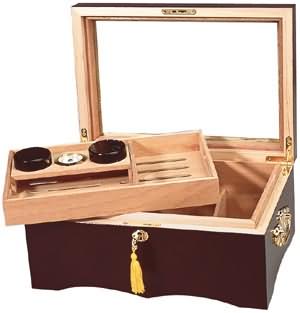
| There are several key
points that all good humidors share. It is important that you chose the
right one in order to protect your precious and delicate cigars. First, is
the interior lining. It should be made of Spanish cedar. A very small
percentage of humidors on the market use a mahogany interior as an
acceptable alternative. The next important feature to look for is the seal
between the lid and the rim of the box. It should be a tight seal, but it
can not be purely airtight. Lids that are very heavy, relative
to the rest of the box, help to promote a sufficient seal. An indicator of
a good seal is when the lid is closed you should feel / hear a small whoosh. Another
critical element to look at is the hinges on the lid. They must be heavy
duty, and be secured with good anchoring. Often, as described earlier, the
lids can be very heavy, and the hinging must be sturdy enough to support
the stress that a heavy lid will put on them. Often, people will say that
the most critical part of a humidor is the humidification element.
However, I disagree. It is actually the only component than can actually
be replaced, therefore, it is more important to have good seals and
hinges, for without them, even the best humidification element will not
keep the cigars in peak condition. These key features are what make a
humidor.
|
| What are some other features that a humidor can have? |
Back to Top
|
| There are several
"options" that your humidor can have. For example, some have
locks, which would prevent people in your office or home from
snatching your stash without your permission. Other humidors have handles.
These not only look elegant, but will aid you when you are moving the
humidor from your beach house back to your winter home. Other important
options that a humidor can have is shelves and dividers. These help you
organize your cigars and keep different brands separated.
|
| What
are the do's and don't when holding or feeling a cigar? |
Back to Top
|
| Premium cigars are
delicate and require care when handling. They can be damaged by squeezing,
pinching, or dropping them. The two ends are the most susceptible to
damage. The rounded, or closed end (nearest to the cigar
band), is called a cap. The cap can be split if it is squeezed too
tightly. The best place to hold a cigar
is anywhere in its middle section, at least 1 inch away from the ends.
|
| How should premium cigars be stored? |
Back to Top
|
| The cigars must be
kept at 70-72% humidity
level to prevent them from drying out. This is best achieved by keeping
them in a humidor. The humidor should have a Spanish cedar lining, to
enhance the aroma and promote the aging of the cigar.
If you are on a budget, there are cigar
jars, made of glass, that will do an adequate job. If you are really in a
pinch you can use Tupperware, or a similar style food storage
container. All of these storage
devices must have a humidification element that releases moisture into the
storage chamber.
|
| Must I use distilled water in my humidification element? |
Back to Top
|
| Yes. Other than the
initial charge of humidor solution, use only distilled water. Tap water and
bottled spring water contain minerals that will collect and slowly
"cake-up" on both the device and the interior of the humidor.
These minerals turn into a whitish/tan crust, and eventually, will clog
the pores of the humidification device and destroy the effectiveness of
the humidor. Additionally, some tap waters often have a slight odor, that
will taint the aroma of the cigars when compounded over months or years.
|
| What is
Humidor Solution? |
Back to Top
|
Humidor Solution, or
Activator Solution as it is sometime called, is a 50/50 mix of distilled
water and propylene glycol. Propylene glycol is a colorless innocuous liquid that has two
favorable characteristics for the use in humidors. First of all the formation of mold as well as bacteria is actively prevented. Secondly, propylene glycol forms a thin layer on the surface of the humidifier, which absorbs humidity at humidity levels of over 70% humidity and which supplies humidity at humidity of less than 70%. This way the humidifier becomes a self-adjusting humidifier and will automatically stabilize the humidity level at an optimum level of approx. 70%.
As distilled water evaporates substantially faster than the propylene glycol part, the humidor should be refilled exclusively with distilled water. This special propylene glycol solution should only be applied when setting up your new humidor or when the humidity level in the humidor suddenly drops. Depending on the outside temperature this is usually once every 3-6 months.
Under no circumstances should the solution be used more frequently and never exclusively. If you do, the humidifier will become saturated with propylene glycol solution and will not be able to absorb more water and thus the humidifier becomes
useless.
|
| Is my humidor supposed to be airtight? |
Back to Top
|
| No. The exchange of
air is critical to the storage of cigars, as it will prevent mold growth. A completely airtight system,
kept at 72% humidity, would grow mold very quickly and destroy the cigars. High quality wooden
humidors, even with seemingly airtight seals, have an exchange of air
because they are made of wood, which is a porous material. However, a
poorly made one will have a seal that is too loose and allow the moisture
to escape rapidly, thus resulting in dried out cigars. If you chose to
keep your cigars in Tupperware or glass jars, it is critical that you open
them at least once a week to refresh the air.
|
| How do I set
up my humidor for the first time? |
Back to Top
|
When most people get their new humidor home, they are anxious to fill it up with their collection of smokes. If you do this without first re-humidifying the wood, you may ruin your cigars. Why? The wood has not had a chance to reach its equilibrium. So when you put your cigars in, the wood will absorb their moisture and you will be left with dry useless cigars. Not exactly the reason you bought a humidor, huh? To solve this problem, all humidors should be re-humidified before their first use.
Re-humidifying your humidor is easy, just follow these simple steps:
Place a shallow container filled with distilled water or activator
solution in the bottom of the humidor
Place calibrated hygrometer inside humidor
Charge your humidification device
Place humidification device inside humidor
You have to check the relative humidity every day. Depending on a number of factors this can take a few days to a few weeks. When you get in the 70 range it is safe to store you smokes inside. As long as you constantly recharge your humidification device you will never have to wait to store your cigars again.
Some people suggest wiping down the inside
of the humidor with a moist cloth to speed up the process. NEVER DO THIS!
Under no circumstances do you want to get the wood wet as that may cause
it to warp or crack, thus rendering the humidor useless.
|
| What happens to a cigar that was left out of the humidor? |
Back to Top
|
| The answer depends on
the environment that the cigar was exposed to and what protection the cigar
had. Cigars often come with an individual plastic sleeve that surrounds
them. This plastic protects the cigar
from drying out for short periods of time. For example, on the ride home
from a cigar store. A cigar with this sleeve that has been out of the humidor for a few hours, or even a day,
will be not be drastically affected by the change in humidity.
However, without this sleeve, the cigar, under low humidity
conditions, can be ruined in as little as 45 minutes. These guidelines are
only approximations, and it is strongly recommended that you protect a cigar
by keeping it in a plastic bag until you can get it to the humidor. Do not
tempt the fates.
|
| What if the cigar has been left unhumidified for longer than a day? For example, say a few days, a week, or even a month? |
Back to Top
|
| After a day or so,
the cigar will begin to dry out. It can be restored by putting it back in the humidor and
leaving it untouched. It will revive itself over time. Generally, it takes
about 2-3 times longer for a cigar to regain its moistness as it did to lose it. For example, if a cigar
was out of a humidor for 2 days, it may take 4, 5, or 6 days to recover,
depending on the humidity of the environment it was exposed to. When attempting to revive the cigar
in a humidor, it should put it as far away from the humidification device
as you possible. Leave it undisturbed for as long as you can, and then you
can slowly move it closer, until you deem it in a smokeable condition. It
is most important to handle the dry cigar
very gently. Remember, it is merely a leaf. If pinched, squeezed or
dropped on the floor, its wrapper leaf may flake, crack, or split. Very
little can be done to save it once this happens.
|
| Can a dry cigar be dipped in water, sprayed with misted water, or put into a steamy bathroom to speed up its recovery? |
Back to Top
|
| Never. The cigar filler will burst through the outer wrapper leaf if the humidity
changes this rapidly. The only procedure known to work is for it to reabsorb the moisture of the humidor very slowly.
|
| How are cigars protected during shipping? Why don't they dry out if it takes more than a day to transport them? |
Back to Top
|
| The cigars are
protected from humidity changes during shipping because they are bulk wrapped in
protective
layers of plastic, which retards the moisture's escape.
|
| Is temperature control an issue? Can they be stored in a refrigerator, third floor attic or a basement? |
Back to Top
|
| Temperature
is only a factor in the extremes. Too much heat (sustained above 80
degrees for 3-4 days or longer) may invite a beetle infestation. This is
the same type of bug that would invade pasta, cereal, raisins, and breads.
Great care must be taken to prevent the cigars from being placed near a
heat source, where this infestation is invited. On the other side of the
spectrum, too much cold will dry out the cigars. Cold air is devoid of humidity
and pulls moisture out of things that have it. This is why lips get
chapped and skin dries out in the winter months. The same holds true for
the cigars. Any home or office that maintains a temperature
control between 60 and 75 degrees provides a suitable environment for
cigars. The colder the room is, the more frequent the humidification
device will need to be recharged with water. Storing cigars in the fridge
or freezer is not recommended for two reasons. First, you must use a
completely airtight container to prevent them from drying out. If the seal
fails, or you accidentally do not tighten it completely, you have
sentenced the cigars to a merciless death. Secondly, even if you have a
good seal, the cold temperature will suspend the maturing and aging of the cigar,
which although is not harmful, is not productive.
|
| Should
I remove the plastic sleeves when I put the cigars into my humidor? |
Back to Top
|
| In general, if you
are "laying down" the cigars to age for any period of time, you
should take the sleeves off and allow the cigars to lay next to each
other. They will pick up the natural aroma of the Spanish cedar, which
will make them age better. I only leave the sleeve on if I know the cigar
will be "moving out" quickly, and I want it to be protected on
its next journey.
|
| Why do experts recommend aging cigars in a humidor before they smoke them? |
Back to Top
|
| Seasoned cigar
smokers feel that aged cigars taste better. The long term exposure to the
Spanish cedar enhances the flavor of the cigar.
Also, many cigars, usually of the stronger variety, will improve, as the
oils bloom through to the surface of the wrapper. Many cigars are just
fine when you buy them, and it is not a hard and fast rule that all cigars
should be aged. However, all cigars will benefit from at least a few weeks
or months in your personal humidor. If you plan on laying down the cigar
for a long period, separate different brands with cedar dividers or the
cedar sheets that often come in the boxes. This will prevent the cigars
from tainting each other with their distinct aromas.
|
| What does Bloom mean? |
Back to Top
|
| Bloom is a
grayish fuzz that can appear on a well aged cigar.
It is not mold, and it is completely harmless. It is a residue from the
fermenting oils within the cigar, and is indicative that you have ideal storage
conditions. You can identify it as bloom if it easily wipes off if you
brush it gently with your finger. If you can not easily remove it, and it
is more of a white color, it is probably mold.
|
| What causes mold? What do I do if I see it? |
Back to Top
|
| Mold will grow if the
humidor is too moist. You must always be conscious of how much water you
are adding to the humidification device. Mold will not grow quickly, so
there are 2 signs that you can look for that will indicate that you are
heading in a bad direction. The first indicator is damp, soggy cigars.
These will be hard to smoke, and may even hiss or burst as you smoke them.
The second sign is a foul, musty odor that greets you when you open the
humidor. If you notice either of these symptoms you should cut back on the
amount of water you are adding to the element, regardless of what your
hygrometer (if you have one) says. It is probably not calibrated and is
giving a false reading. If you spot mold on a cigar
remove it immediately from the humidor, as it will spread to others.
|
| What
is the Tobacco Beetle? |
Back to Top
|
| The dreaded beetle is
a tiny little bug that will infest tobacco. You may see the beetle, about
the size of a large grain of sand, crawling around your precious stogies.
Often, though, you may not see the actual beetle, as it can crawl within
any one of your smokes and hide undetected. However, there are two
telltale signs that you have been infested. The first, is that you will
notice that small holes have been bored through the cigars. These holes
are about the same size as if you punctured the cigar
with the end of a paperclip. The second signature is the nasty bug will
leave piles of small charcoal colored sand in the humidor. This is beetle
excrement. This stuff is often accumulated inside the cigar
too, and if smoked, will leave a harsh bitter taste in your mouth. The
burning aroma will also be very unpleasant. Your spouse or roommates will
perceptively remark, "what the hell are you smoking, s...?"
Unfortunately, they will have nailed it right on the head.
|
| How
did the Tobacco Beetle get into my humidor? |
Back to Top
|
| The beetle has been
hatched from eggs that came hidden on one of your cigars. They can hatch
whenever the ambient temperature
of the cigars rises above 80 degrees and is sustained for a few days.
These extremely tiny eggs were laid on the leaves while the plant was
still in the fields. They are undetectable, and therefore, unremovable
during the any part of the processing and handling. These eggs may exist
within every cigar
in your collection, or none at all. The guilty cigar
can be the most expensive prestigious brand you own, or the cheapest. The
bug is not brand conscious or prejudiced, all cigars taste good to the
beetle.
|
| What
can be done to prevent the Tobacco Beetle from infesting my stash, and
what can I do if they have already stricken? |
Back to Top
|
| Fortunately, these
bugs do not like freezing cold temperatures. You can place the cigars in
the freezer for 4 days. The freezing cold temperature
will kill off all the bugs and its larvae. However, there is a strict
procedure that must be adhered to in order to prevent the complete
ruination of your collection. First, take all the cigars and place them in
airtight plastic bags. If there is even the slightest gap in the seals the
cigars will lose all humidity
and be destroyed. I repeat this procedure twice more, so that the cigars
are protected by three layers of plastic. Place the package in the freezer
and leave it there for 4 days. Meanwhile, you can thoroughly wipe down the
inside of the humidor (using distilled water, of course). Make sure there
are no little critters hiding in the corner. Once the 4 days have passed,
take the package out of the freezer and place it in the refrigerator for
12-24 hours. Be very careful when handling the package, as the cigars will
be very brittle. After this time in the fridge, take them out and let them
warm up to room temperature.
This will take at least 4-6 hours. The larger the package, the longer it
will take to get the core to rise to room temperature.
Once this is done, you can now replace your sterilized smokes back into
the humidor.
|
| Can I freeze all incoming cigars as a preventative measure? |
Back to Top
|
| Yes, I firmly believe
in this procedure. As long as the procedure above was carefully followed and the
cigars were not directly exposed to the freezing air, you will not have a
problem. Many will scoff at the procedure, as they do not want to be
bothered with the time and effort. However, if you have ever lost a batch
of 8 year old cigars that you were saving for just the right occasion to
these merciless creatures, the precaution is no trouble at all.
|
| How do you know where the cigar is from, if it is made from tobaccos of different countries? |
Back to Top
|
| A cigar's country of
origin is classified by where it was rolled, regardless of where the
wrapper, binder, or filler is from. Typically, the filler tobacco is
usually grown in the same country as where the cigar is made. This is not
an absolute rule, as cigars rolled in the US, (typically, Miami or Tampa
regions) must import all of their filler. Another exception is Honduran
and Nicaraguan cigars, as their native grown fillers are often too harsh
to be used exclusively, and are typically blended with Dominican filler in
order to produce an acceptable smoke.
|
| What
are the different tools used to cut the cap off the cigar? |
Back to Top
|
|
There are several methods of cutting the cigar. Here are the most
common accessories on the market.
Cutters: A cutter is a guillotine style device used to slice the
cap off of the cigar. It is the most common type, and is available as a
single, double, and even triple blade. The single and double blades are
the most common. Most double blades cutters are more expensive than the
single blades, but they will last far longer, as they are self-sharpening.
Most single blade cutters are disposable, and should be thrown away once
they have stopped making a clean, sharp cut. If you buy an expensive gold
or silver single blade cutter, be sure that the blade is replaceable, or
else you will have just spent a lot of money on a disposable cutter.
Scissors/Clippers: These scissor-action clippers work the same
way that the double blade cutter does. However, they are not self
sharpening, and can crush or tear the head off the cigar if they are not
kept at peak sharpness. They do not fit comfortably in a pocket, and
therefore the lack of portability makes them attractive for home use only.
Wedge Cutter: These cut a "V" down the center of the
cap, about an 1/8-1/4" deep. Typically, they work very well on thin
(less than 40 ring size) and tapered (torpedo shaped) cigars. They do not
give a clean cut on the thicker heads.
Punch: A punch cuts a small circle into the cap. A well designed
one can have an ejection spring to push out the cut tobacco. The punch
does not work well on thin cigars. It works well on thick cigars,
especially the oversized ones of 54 ring gauge or more. Often a guillotine
cutter can not accommodate these mammoths. Also, the punch hole in these
giants relieves you from having to put the whole cigar in between your
lips, which can be uncomfortable on the jaw. Rather, you can
"sip" the smoke through the punch opening.
Poker/Piercer: This is a pin-like rod that just pokes a hole in
the cap. It does not allow a good draw, which can cause the cigar to burn
improperly, or provide its full flavor. It also causes a build up of
bitter tars at its opening, once you have been smoking the cigar for a
while. Therefore, a piercer is not recommended on anything larger than a
short, thin cigar.
|
| How
do I carry my cigars around when I travel or just go out for the day? |
Back to Top
|
|
You must protect the cigar in some fashion, as it will either dry out
or get bruised. Here are the options you can chose which best suits your
needs.
Tubes: A tube will hold one cigar. If it has a good seal, it
will protect it for many days or even weeks. They can be constructed of
any type of material, ranging from plastic to platinum, and will be priced
accordingly. Some even have tiny humidification devices built in, but this
is not necessary for short term use. The only downside to these carrying
tubes is that if your friend has one it means that he did not bring a
cigar for you.
Finger Cases: These are cases made from either leather, metal,
wood, or plastic. They will have 2-4 "fingers" for the cigars.
The leather models are soft cases, and are most often made from 2
telescoping pieces, that slide within each other. They are made for
specific length cigars, but will often handle a variance of 1-1.5 inches
more than they were designed for. Sometimes they have individual slots for
each cigar, but these are not absolutely necessary. These cases will
provide several hours of protection and are perfect for a night out. They
are not heavy and will not show a bulge by weighing down your shirt or
jacket pocket. The metal, wood, or plastic varieties are hard cases,
providing more protection from both the elements and from being crushed.
However, they are bulky, will pull down on your clothing, if they even fit
into the pockets. They are more suited for carrying in a briefcase or golf
bag. Elaborate ones can have miniature humidification devices, but these
are only necessary if you want to insure the cigar's freshness for an
extended period of time.
Travel Humidors: Travel humidors are miniature humidors,
complete with a humidification element. As the name implies, they are used
when you need to take your smokes out of town. They will hold between 4
and 20 cigars, depending on size. They are made from wood, metal, plastic,
or any combination of these materials. As this is a short term storage
unit, a Spanish cedar lining is a nice cosmetic touch, but not an
automatic prerequisite. There are many poorly designed models on the
market, and you should look for the following features and pitfalls when
considering the purchase. First and foremost, the seal must be a good one.
The seal on travel size humidors should either have the same type of
interlocking "lips" that a full size one has, or a gasket of
some kind. You need to be confident that moist air is not escaping.
Another important feature is the interior protection it offers for the
cigars from being knocked around. Will they continue to slam into each
other or the walls of the unit? Well designed ones will be built very
thinly, so that you can only stack the cigars in one or two layers, thus
minimizing the potential for damage. Good alternatives to keeping the
cigars in place have grooves cut into them (usually molded plastic), foam
egg cushions, or straps that act as seatbelts. These features are useful,
but not completely necessary, as you can always put some balled up bubble
wrap into a half filled humidor to prevent them from jostling. This is not
exactly elegant, but extremely functional. The last key factor when
examining a travel humidor is its strength. You want the unit to stand up
to external stress, without breaking. A good, functional travel humidor
will have all of these features.
|
| What
makes a proper lighter for cigars? |
Back to Top
|
| There are 2 critical
features you should look for. First, the type of fuel it uses. It must be
a clean burning fuel such as butane. Most other lighter fuels give off a
chemical or kerosene-like odor that will alter the taste of your cigar.
Secondly, the lighter must provide a large enough flame to light the whole
cigar. For some reason (probably to conserve fuel), many disposable
lighters no longer have an adjustable flame, and only burn at about a
3/8th inch tall. This is too small, so cigar smokers must find one that is
a designed with cigar needs in mind. The "blowtorch" style
lighters have become very popular, because they burn at an extremely high
temperature, and can do the job from several inches away. Remember, to
properly light the cigar, you never want to actually put the foot directly
into the flame. The larger and hotter your flame is, the further away you
can keep the cigar from it and gently draw the heat up.
|
| What
makes a good ashtray for cigars? |
Back to Top
|
| Ashtrays are more
important than you think, and there are three features to look for. First,
the ash container must be large or deep enough to hold all the ash-drops
that a cigar creates. Second, it should be sturdy enough to absorb an
incidental shock without getting tipped over. Third, it should have a
groove wide enough to support a cigar on a horizontal level. The cigar
should not be tilting down with the coal resting in the base of the tray.
This can suffocate the one side that is touching the tray and cause the
cigar might to burn unevenly. Remember, if you are taking a puff every
minute or so, you should be keeping the cigar safe and sound in a good
ashtray the rest of the time. You can not just keep it in your hand the
whole time, as you will not be able to juggle the remote control and your
single malt.
|
| Does
my humidor need a hygrometer? |
Back to Top
|
| It is a nice feature,
but not necessary. It is always more important to feel your cigars and
judge how they are smoking than rely on the reading of the hygrometer. Do
they crackle when you cut the cap, does the wrapper flake when you handle
them? If yes, they are too dry. Its time to add some water. Do they smell
musty, feel spongy, sizzle or split when you smoke them? If yes, they are
too moist, and you added water too much or too often. Back off on the
water for a while. If it is alarmingly damp n there you can stick a few
cedar planks (provided from a box of cigars-you can break off the lid or
sides if you need to) into the humidor for a few days to absorb the excess
moisture. New smokers are obsessed with the reading of the analog
hygrometer. Even a correctly calibrated analog model has a variance of
5-10%. Therefore, you need to let the cigars tell you if you are
maintaining them properly. Only operators of commercial storage or
"walk-in" humidors need to keep an eye on the humidity as they
usually don't touch and feel the cigars as we do. If you are completely
obsessed with having an accurate hygrometer you can go to Radio Shack and
blow 40 bucks on a digital one.
|
| How
do I calibrate my analog hygrometer? |
Back to Top
|
| Dampen a towel (not dripping
wet, but good and damp), then wrap the hygrometer in the towel for 30 to
45 minutes. Then unwrap it and read the humidity (quickly). If your
hygrometer is perfectly calibrated (few are) it will be reading exactly
100% humidity. Most likely, it will be reading somewhere between 80 and
90%. That's ok - if it's reading 90%, then you know that when it's in your
humidor and reading 65, your humidor is really at 75%. From now on you can
just make this simple adjustment and you won't have to mess with the
calibration screw.
Want to get a little more technical? No
problem. Luckily, as nature would have it, when salt and water (NaCl and
H2O for you studious types), are in a saturated solution at equilibrium,
the resultant humidity is 75%. This gives a fantastic reference point
to calibrate our hygrometers.
Here's the procedure you should use:
Get a bottle cap of some sort - like the
kind you might get off of a beer! Fill it with regular table salt.
Then drop a few drops of water on the salt. DO NOT put to much water on
the salt. The salt should only be damp, and not a liquid solution. It
should be like moist sand, not like soft mud.
Then put the bottle cap of salt and your
hygrometer in a see-through, sealable container. I like to use a large
freezer bag. Seal the freezer bag or other container. Wait several hours
(about six). The humidity inside the bag will be 75%. Compare it to your
hygrometer. You will then know exactly how far off your hygrometer is,
just like with the damp towel test, above.
Take your hygrometer out of the
humidor and wrap it in several layers of dripping wet paper towels. Leave
it alone for 5 minutes. During this waiting, go find your
"precision" screwdriver set. Once you have found it, go and
unwrap the hygrometer unit. If it is operating correctly, it should be
registering between 95-100. If not, take the appropriate size screwdriver
and stick it through the hole on the bottom and look for a screw that
looks like it is connected to the axis of the dial's needle. Turn this
screw to until the dial reads 95. If you took more than 1 minute to find
the screw and turn it, then repeat the entire process, to ensure you have
calibrated it as accurately as you could. You may have to go through this
ritual every 3-6 months to ensure as much accuracy as possible. But
remember, even a properly calibrated analog hygrometer can have a 5-10%
error rate, so always keep that in mind if you think you have a problem
with your moisture level.
|
|
|
|